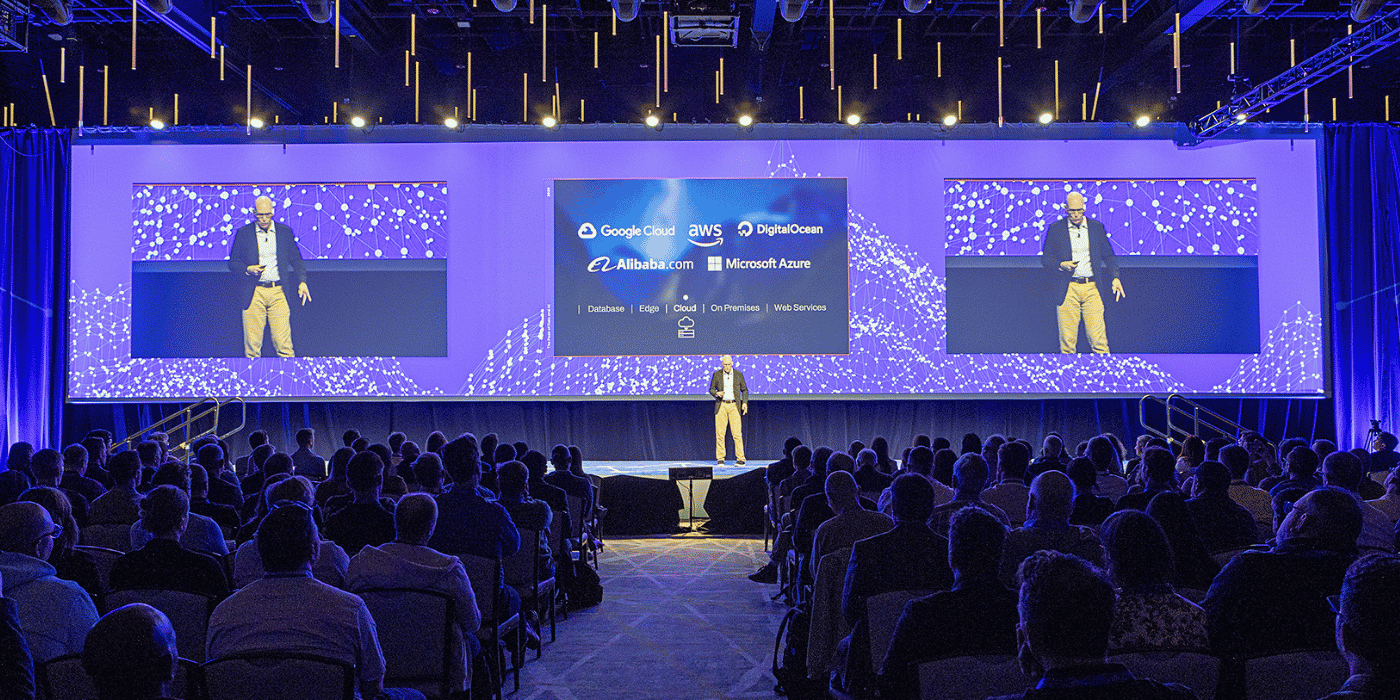
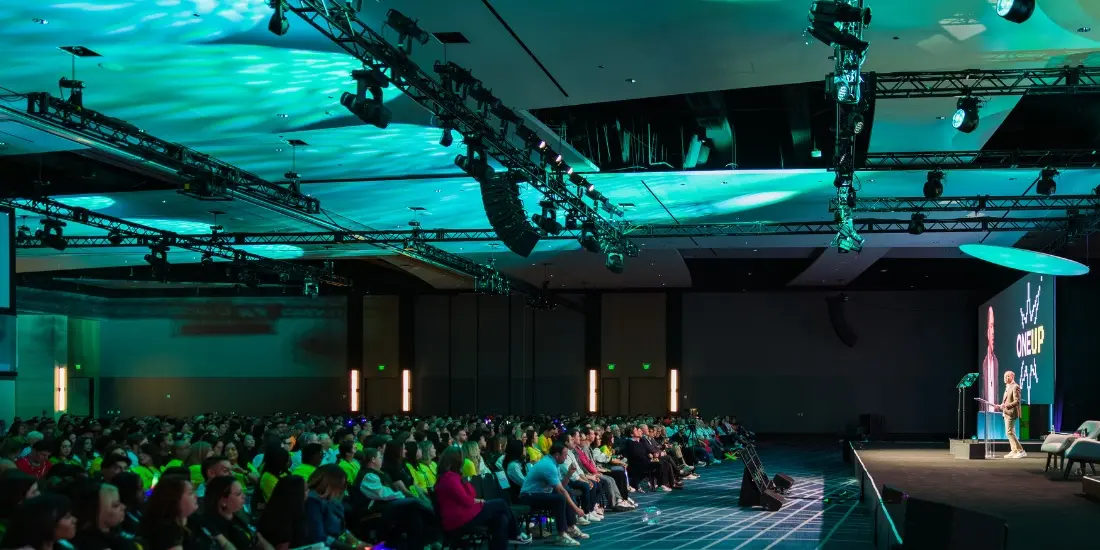
Let’s imagine an enterprise marketing team that has four flagship events on the calendar this year: a sales kickoff in January, a user conference in March, a partner summit in July, and an investor day in October.
Each one has its own RFP, its own production team, its own creative brief, and its own debrief. And almost no one in the room has asked how they should reinforce each other.
If this sounds familiar, you’re not alone. Many clients come to us with a program-design gap. Four events sharing recurring stakeholders, shared brand assets, and a single annual narrative arc — but planned as if they were four unrelated projects.
However, your events are not parallel productions. They are a sequenced system that builds on itself. Treating them that way is one of the highest-leverage shifts an enterprise events program can make this year.
Most Enterprise Event Calendars Are Separate Projects Running in Parallel
Here’s what we see at many enterprise organizations producing 4–10 flagship events per year:
- Four separate RFPs issued by four different stakeholders on four different timelines
- Four production teams who have never worked with each other and don’t know your brand standards
- Four creative briefs that reference the annual theme inconsistently or not at all
- Four post-event debriefs that only lightly feed forward into the next event
- Four invoices, four mobilization costs, four learning curves
This is a coordination problem disguised as a production problem. It gets framed as production because the symptoms show up at load-in: brand colors slightly off, stage dimensions that don’t match the user conference layout, a run-of-show structure your CEO has to re-learn at every event. The real cost lives upstream in the strategic compounding that never happens because each event starts at square one.
The simplest test: Ask whoever owns each event on your calendar to name the takeaway from the previous flagship event in the sequence. If they can’t, this is a sign you have more of a project list than a program, and there’s room to steer the ship right.
What a Program Calendar Actually Looks Like
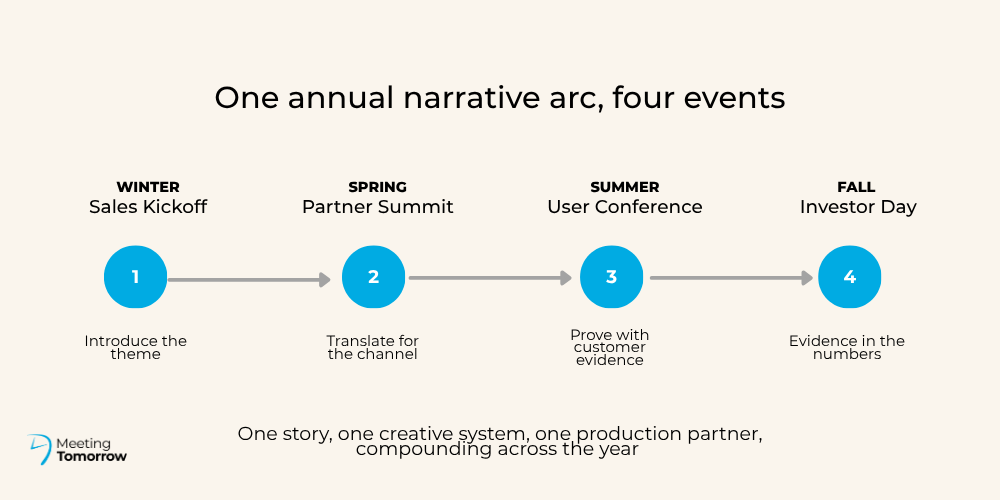
A program calendar treats four events as one annual arc.
Here’s an example: The SKO introduces the strategic theme for the year. The partner summit then translates that theme for the channel. The user conference proves the theme is real with customer evidence. The investor day evidences it again, with the financial metrics behind it.
That’s the same audience set — your C-suite, your board, your largest customers, your channel partners, your analysts — encountering a single story four times in twelve months, each time reinforced by the production environment they experience it in. The stage design, run-of-show language, speaker prep process and technical spec is consistent.
Practically, that means:
- One creative system designed once, then adjusted and deployed four times — not four creative briefs written from scratch.
- One stage design language that scales from a 400-person SKO ballroom to a 2,500-person general session at the user conference.
- One run-of-show framework your CEO walks into already knowing.
- One production partner carrying institutional memory across all four events.
- One annual debrief that feeds forward, not four isolated ones that disappear into a shared drive.
How Sequencing Creates Compounding Value Across the Year
The four events are not interchangeable. Let’s go back to this example:
Introduce in January at the SKO. The sales team is the first audience to hear the year’s strategic narrative, because they’re the audience that has to carry it into every customer conversation for the next twelve months.
Translate in the spring at the partner summit. Your channel takes what the SKO introduced and adapts it for their go-to-market motion. The story has to be the same — the audience and the application are different.
Prove in September at the user conference. By this point, the strategic narrative needs to be visible in customer evidence — case studies, product launches, customer-led sessions. The audience sees the strategy delivered, not promised.
Evidence in the fall at the investor day. The financial story closes the arc. The strategy your sales team carried in January, your partners adapted in the spring, and your customers validated in September now shows up in the numbers.
When this chain holds, your credibility compounds. When it breaks, you rebuild credibility at every event instead of compounding it. Inconsistency is visible across a program in a way it isn’t across a single event.
The Shared Assets Most Teams Are Rebuilding From Scratch Every Quarter
Here’s an example of the asset inventory we’d run before the next planning cycle starts:
- Stage design system. Modular set design that scales across ballrooms, general sessions, and broadcast environments designed once, refit per event.
- Brand templates for the production environment. Lower-thirds, speaker IDs, session transitions, hold slides. Most teams have brand standards for keynote decks. Far fewer have them for the production overlay.
- Run-of-show framework. A standardized structure for keynote pacing, transitions, awards moments, and Q&A so the C-suite walks into each event with a structure they already know.
- Speaker briefing documents. Prep packets, walk-through scripts, technical rehearsal protocols.
- Technical spec library. Camera package, audio package, broadcast specifications, redundancy requirements documented once, deployed every event.
- Vendor and venue contact directory. The institutional memory of who runs what at every venue you return to.
In a project-by-project model, this work is rebuilt at every event. In a program model, it’s built once and amortized across the calendar. The first event in the cycle absorbs more strategic design work; every subsequent event benefits from it. That’s the production-economics argument, and it’s a CFO argument as much as a creative one.
A Self-Assessment: Program or Project List?
Before your next planning cycle, run this diagnostic on your current calendar. Six questions, honest answers.
1. Narrative arc. Can you state, in one sentence, the through-line that connects your four flagship events this year? If you need more than one sentence, the arc isn’t designed.
2. Asset reuse. What percentage of the production design from your last flagship event is being reused at your next one? If the answer is near zero, you’re rebuilding from scratch.
3. Recurring stakeholders. Which C-suite speakers, board members, customers, or analysts appear at more than one event on your calendar? List them. That list is your consistency-pressure audience.
4. Production model. How many independent production teams are working your calendar this year? If the answer is more than one, who carries institutional memory between them?
5. Run-of-show consistency. Would your CEO recognize the production structure of your IR day as related to your SKO? If not, the format itself is creating friction at the top of the org chart.
6. Debrief flow. Does the debrief from your last flagship event live in a document that informs the next one — or did it disappear into a shared drive?
If you answered “no” or “don’t know” to three or more, you have a project list. That’s not a failure! It’s the default state of most enterprise event calendars. It’s also the highest-leverage thing to fix in your next planning cycle.
How to Start Treating Your Calendar as a Program This Year
Three practical moves to start the shift, regardless of what’s already on the calendar:
- Map the full year before you brief the next event. Pull all four flagship events onto a single page. Identify the narrative arc, the recurring stakeholders, and the shared assets before you write the next creative brief.
- Consolidate the production relationship. One dedicated team across the calendar is the mechanism that makes program-level thinking executable. Four independent relationships are the mechanism that prevents it.
- Build the asset library once, deploy it four times. Stage design system, brand templates, run-of-show framework, technical spec — built into a program library, not regenerated at each event.
Talk to Our Team about how a program-level production partnership could change the economics of your annual calendar, or Send Your RFP to [email protected].

Kathleen Costanza is Meeting Tomorrow’s Content Manager, where she shapes and executes the Meeting Tomorrow’s content strategy to bring its brand to life. With more than 10 years of experience in B2B and nonprofit marketing, she creates thoughtful, high-quality assets across web, email, social, and sales channels, ensuring every piece reflects Meeting Tomorrow’s voice and makes life easier for busy event planners. Her work helps meeting professionals discover ideas, tips, and resources to make their events shine. Outside of work, she enjoys photography, quilting, and getting lost in a good documentary.