


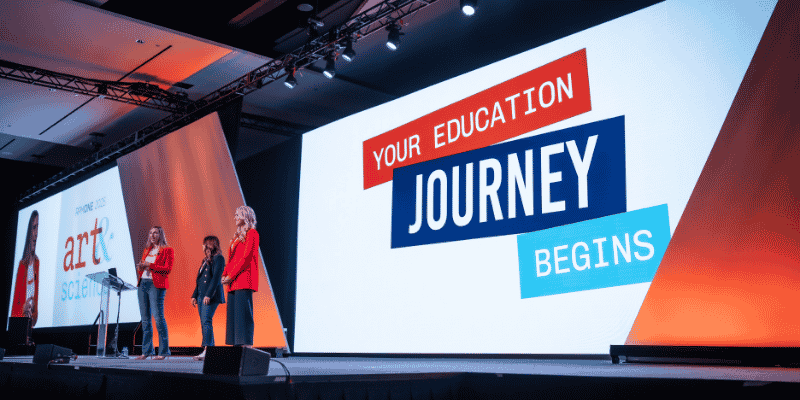
The mainstage is the single most-photographed square footage of any annual conference or sales kickoff. It sits behind every keynote, in every recap video, and in every post-event share your team pushes out for the next twelve months. And yet, the scenic package behind it is often the last thing selected and the first thing compromised — pulled from a catalog, priced by the linear foot, and briefed off an AV spec sheet rather than a brand brief.
For marketing directors who own the annual conference and the SKO, this is a solvable problem. It just requires treating the stage the way you treat a campaign creative asset: as an expression of the brand, produced against the brand’s standards, and evaluated by the same criteria you’d apply to any other high-visibility brand moment.
Why the Mainstage Is Your Brand’s Most Expensive Underutilized Asset
Don Jeter, CMO at Torq, put it bluntly in Event Marketer’s 2026 Fab 50: “If you’re not putting on a show, you’re just paying for a spot on the carpet.”
The quote is about trade show floor presence, but the principle carries over to owned events. If your mainstage is a generic scenic package with your logo dropped onto a stock screen, you are paying full production cost for a moment that does not do brand work. The lighting, the LED, the scenic build, the front-of-house design — all of it is being produced. The only question is whether it’s producing something recognizable as yours.
A useful self-assessment: pull the widest shot from your last event’s recap video. Remove the logo from the screen. Would anyone in your audience — investors, top customers, senior sales leaders — know whose event this was? If the answer is no, the stage is doing operational work but not brand work.
What “Generic Conference Furniture” Is Actually Signaling to Your Audience
Sophisticated audiences read production quality the same way they read a pitch deck. It’s a signal of how the organization operates.
The environment outlasts the content. That is not a soft insight — it’s the actual data on how business audiences retain event impressions. And it applies in the other direction, too: a stage that looks provisional, catalog-assembled, or last-minute signals operational default. Not scarcity — default. It tells the audience the organization did not treat this moment as important enough to design intentionally.
For a marketing director trying to defend an event budget to a CFO, this is the exact wrong signal to send. The audience arrives ready to be impressed by the brand, and the room quietly tells them not to be.
The Five Elements That Turn a Stage Into a Brand Environment
Brand-led stage design isn’t about spending more. It’s about resolving five specific design decisions against the brand — not against the venue’s default rigging plot or a production partner’s standing inventory sheet.
1. Scenic architecture. Shape, depth, and material. Is the stage a flat wall with a screen, or does it have structural depth that reads as intentional? Custom scenic doesn’t have to mean custom fabrication from scratch — modular systems configured against your brand’s spatial language will outperform a flat backdrop every time.
2. Lighting color and quality. Your brand color system exists in Pantone and hex. On a stage, it exists in gel colors, LED fixture temperatures, and the interaction between wash lighting and the audience. If your brand palette hasn’t been translated into a lighting design, you’re improvising it on load-in day.
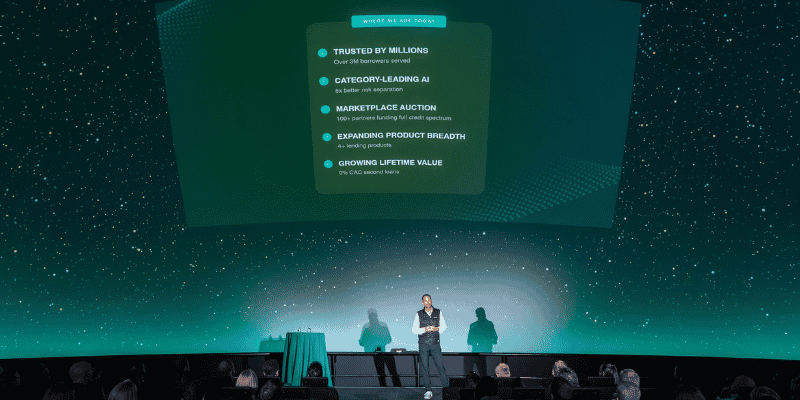
3. LED content and motion design. The LED wall behind the podium is a canvas. Static logos on a loop are the visual equivalent of a placeholder slide. Motion design that carries your brand’s animation language — the same treatment you’d approve for a broadcast spot — turns the wall into an active brand surface.
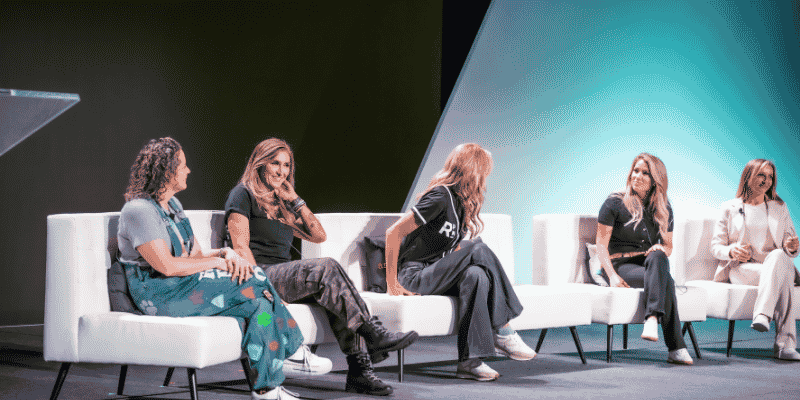
4. Branded moment framing. The podium, the interview set, the panel configuration. Each of these is a repeatable frame that will end up in dozens of photos. Designing each frame as a brand composition — not just a place to put a chair — is what makes recap content look intentional instead of documentary.
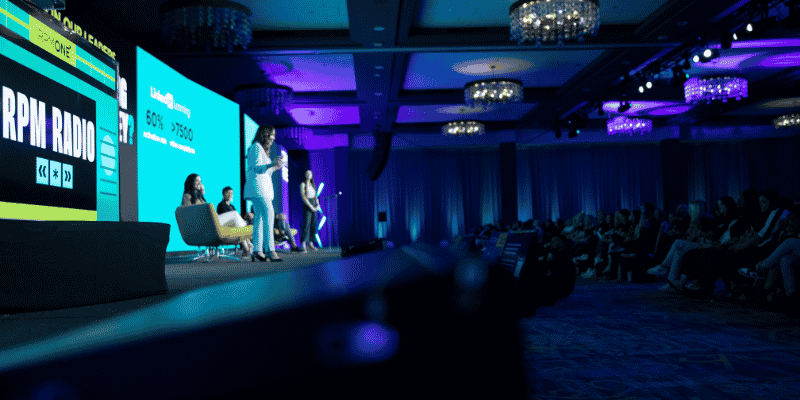
5. Front-of-house sightlines. What the audience sees from row 15 is different from what the camera sees at center-cut. A brand-led design resolves both views before the room is built.
How to Brief a Production Partner So the Design Reflects the Brand
The brief that produces generic scenic looks like this: room dimensions, screen size, session count, budget cap.
The brief that produces brand-led scenic starts earlier and includes more of the brand’s connective tissue: the color system with its actual usage rules, the typography with its hierarchy, the motion language used in the current campaign, reference images from other brand moments (owned media, retail environments, campaign photography), and a clear articulation of the audience and what the organization wants them to feel.
This is not a design deck. It’s a working document that gets handed to the production team the same way it would get handed to an agency creative team — because the production team is doing creative work, whether it’s been briefed that way or not.
Holly Ransom, speaking at the PCMA Business Events Summit, framed the challenge as building environments where high-signal thinking can happen. The takeaway for event teams: the room itself is either amplifying the signal or adding noise. There is no neutral option.
What a Brand-Led Scenic Process Actually Looks Like in Practice
A brand-led scenic process is not a two-week turnaround. It is a 6–12 week iteration cycle at minimum that runs in parallel with content development, not sequentially after it.
- Weeks 1–2: brand brief handoff, reference gathering, and two or three initial scenic concepts.
- Weeks 3–5: direction selection, refined scenic renderings, lighting design pass, LED content treatment concepts, and color testing against the LED wall to confirm the brand palette holds up under stage conditions.
- Weeks 6–8: technical drawings, rigging plots, content production, and scenic pre-build.
- Weeks 9–12: content finalization, load-in planning, and dress rehearsal. This is where a production partner who has done your events before earns their fee — they carry forward what worked last year and what didn’t, without needing to be re-briefed from scratch.
That institutional continuity is the piece most teams underestimate. When the creative team and the production team are siloed — or when the production crew rotates every event — the brand language gets re-translated every cycle, and something is lost in every translation.
How to Evaluate Whether Your Current Scenic Package Is Working
Five diagnostic questions for a marketing director reviewing the current program:
1. If you pulled a wide shot of last year’s mainstage and removed the logo from the screen, would your audience know whose event it was?
2. Are the brand colors in your lighting design specified against your actual brand palette, or picked from what the venue had in stock?
3. Did your production partner review your brand guidelines before the scenic concept was drafted?
4. Does your LED content match the motion language of your current campaign work, or does it default to generic transitions?
5. When you compare your recap video to your best campaign work, does the production quality feel like the same brand?
If three or more of these land on the wrong side, the scenic package is under-delivering on the budget it’s already consuming. The fix isn’t more money — it’s earlier brand involvement and a production partner who treats the stage as a brand surface.
Attendees increasingly evaluate an organization by the intentionality of its event environment. The stage is not a neutral container. It is either building the brand’s authority or quietly undermining it.
What to Ask Before You Sign the Next Production Contract
Before the next scope goes out, three questions that will surface whether the production partner is set up to do brand-led work:
Who is on the account, and will they still be on the account next year? A dedicated team that knows your brand year over year builds institutional knowledge that a rotating crew cannot. The value compounds. The alternative — a different team every event, briefed cold each cycle — has a cost that shows up in the details.
How early do they want the brand brief? A partner who wants it in week one is set up for brand-led work. A partner who wants the AV spec sheet in week one is set up for equipment delivery.
If your mainstage is the biggest brand asset your event program produces, it deserves the same rigor you apply to every other brand asset.
Talk to Our Team about what a brand-led scenic process could look like for your next annual conference or SKO — or Send Your RFP to rfp@meetingtomorrow.com.

Cindy Chea is the Content Specialist at Meeting Tomorrow. Whether it’s design, research, social media, or writing, she loves all things content and applying it to the world of events. A digital storyteller at heart, she thrives on transforming complex information into engaging, visual stories. At Meeting Tomorrow she helps ensure brand consistency across our platforms and develops creative content solutions for our team and the event professionals we support. When she’s not editing or looking for event inspo, you can find her journaling in a coffee shop or searching for the best bread basket in Philly.


