

At PCMA’s 2026 Business Events Summit in San Juan, futurist Shawn DuBravac argued that meeting planners are already wired for change — and that the next move for event program leaders is a shift from task-focused execution to strategic leadership. In his talk, “From Operator to Orchestrator: The Next Shift in Strategic Event Management” (covered by PCMA Convene), he framed this as the move from Operator to Orchestrator.
The framework resonates. But when you sit down to look at your own program, it’s challenging to make changes if you don’t have a structured way to measure where you’re still defaulting to operator mode and where there’s space to move into orchestrator mode.
This scorecard is that measurement tool. It won’t tell you whether your last event was good. It will tell you whether the way you run your program is set up for reactive execution vs long term, strategic success.
The Strategy Spectrum
Most enterprise event programs live on a spectrum. For example, a Director of Events at a $2B software company can run a genuinely strategic annual user conference but still be stuck in operator mode on the 14-city regional roadshow. Or a VP of Marketing can own an SKO with clean KPIs but have no measurement discipline around the partner summit.
The reason most leaders can’t locate themselves accurately on the spectrum is that operator work feels productive. Answering a vendor email, approving a floor plan, chasing down a signed BEO — these all visibly move the event forward. They’re also the tasks that keep you out of the strategic conversations that determine whether the event mattered.
PCMA Convene’s recent podcast surfaced research from Angelika Bazarnik on what the publication called a hidden stress crisis among planners — evidence that the execution load isn’t an individual productivity problem, it’s often a structural condition of the role. Which means diagnosing it needs a structural tool.
What “Operator Mode” Actually Looks Like in Practice
Before the scorecard, a quick reality check on the symptoms. Operator mode has a look:
- Vendor cadence is reactive. You respond to what shows up in your inbox rather than driving the schedule.
- Scope is defined by logistics — room block, catering count, stage size — before it’s defined by business outcome.
- Post-event measurement is anecdotal. “It felt great in the room” is the metric.
- Institutional knowledge lives in one person’s inbox or head, not in a shared system a partner can pick up.
- The debrief, if it happens, is a hot-wash of what went wrong. It rarely includes what the program should stop doing.
- Cross-functional partners (product marketing, sales enablement, comms) get looped in late.
- Budget conversations with finance are defensive, not framed around ROI or ROE.
If three or more of those describe your last two events, the scorecard is worth ten minutes.
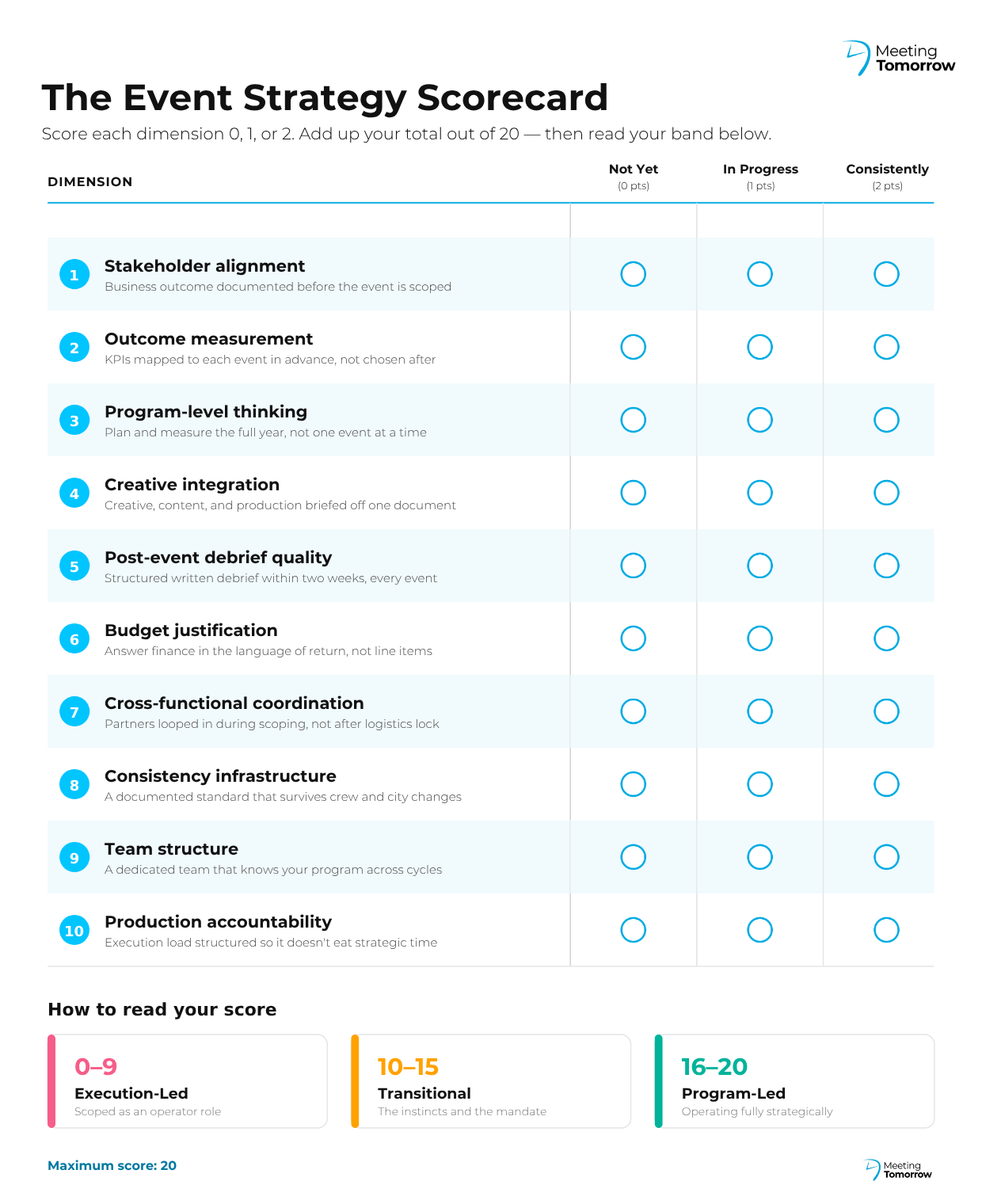
The Scorecard: Score Your Program on 10 Dimensions
Score each dimension 0, 1, or 2. Zero means “not yet.” One means “in progress or partially in place.” Two means “consistently, across the program.”
- Stakeholder alignment. Before an event is scoped, do you have a documented conversation about the specific business outcome the event exists to produce?
- Outcome measurement. Do you have a defined KPI set (pipeline influenced, NPS, sales-cycle acceleration, retention lift) mapped to each event before it happens, not chosen retroactively?
- Program-level vs. event-level thinking. Do you plan and measure at the program level — the full year of touchpoints — or one event at a time?
- Creative integration. Are creative, content, and production briefed off the same document, or do they run parallel workstreams that meet on-site?
- Post-event debrief quality. Do you run a structured debrief within two weeks of every event, with a written output that feeds the next planning cycle?
- Budget justification methodology. When finance pushes back, can you answer in the language of return — pipeline, retention, employee engagement — rather than in the language of line items?
- Cross-functional coordination. Are product marketing, sales, or other key stakeholders looped in during scoping, or notified after logistics are locked?
- Consistency infrastructure. If your program runs across multiple cities, is there a documented standard that survives crew changes, or does quality depend on which city you’re in?
- Team structure. Do you have a dedicated production team that knows your program across cycles, or are you re-briefing a new crew every event?
- Production accountability. Is the operational load of running events — crew, logistics, on-site execution — structured so it doesn’t consume the time you need for strategic work, or does the day-to-day of production keep pulling you back into operator mode?
Maximum score: 20. Add it up before you keep reading.
How to Read Your Score (and What to Do with It)
16–20: Program-Led. You’re operating as an orchestrator. Your job now is to protect the structure — the biggest risk to a program-led leader is a reorg or a new stakeholder who wants to “streamline” the parts of your model that make it work.
10–15: Transitional. You have the instincts and probably the mandate. The gap is usually in one or two dimensions — most often production accountability (question 10) or consistency infrastructure (question 8). Fix those two and the rest tends to follow, because those two dimensions are the ones that eat the most of your calendar.
0–9: Execution-Led. This is not a judgment; it’s a diagnosis. The role has been scoped as an operator role, and every incentive in your day is pulling you toward task completion. The move out of this zone is rarely about working harder — it’s about restructuring where accountability lives.
How to Start Moving Toward Orchestrator Mode
Scoring the gap is the easy part. Closing it is a handful of deliberate moves and most of them require no reorg, no new budget, and no vendor. They’re changes to where your attention goes and what you refuse to own.
Get the outcome in writing before you scope anything. The defining habit of program-led leaders is that they won’t brief a room block, a stage, or a creative direction until the business outcome is documented and ranked. If the goal is still “a great event” when the venue contract is signed, every downstream decision defaults to logistics. Force the outcome conversation upstream, even when the strategy meeting didn’t include you — ask for the goal in writing and attach it to the brief.
Systematize the repeatable layer so quality stops depending on you. Operator drift thrives when every event rebuilds from scratch. Document the parts that don’t need to be reinvented each time — the run-of-show framework, the technical spec, the brand templates for the production environment — so they’re assets your program owns, not knowledge you re-explain each quarter.
Move institutional memory out of your inbox. If the history of your program lives in your head and your sent folder, you are the single point of failure — and you’ll spend strategic hours as a human search engine. Put debriefs, decisions, and standards somewhere shared and durable, so the next cycle starts where the last one ended.
Stop being the integration layer. When creative, content, and production arrive as three separate briefs from three separate providers, someone has to stitch them together on the fly — and by default that someone is you. Consolidating those workstreams, however you do it, hands that time back.
Reframe the finance conversation before finance reframes it for you. Walk into the budget review with a program-level scorecard instead of an event-by-event recap, and the discussion shifts from defending line items to justifying investment in the language of return — pipeline, retention, engagement.
What Changes When You Close the Gap
The visible change is that the debrief gets better: instead of “the audio dropped in breakout three,” you’re talking about whether the event moved the metric it was scoped to move.
The less visible change is with your executive sponsor. Show up to the quarterly review with a program-level scorecard rather than an event recap, and the conversation shifts from budget defense to program investment. That’s the difference between measuring an event and measuring the impact.
If you want help honing your event strategy, Talk to Our Team.

Kathleen Costanza is Meeting Tomorrow’s Content Manager, where she shapes and executes the Meeting Tomorrow’s content strategy to bring its brand to life. With more than 10 years of experience in B2B and nonprofit marketing, she creates thoughtful, high-quality assets across web, email, social, and sales channels, ensuring every piece reflects Meeting Tomorrow’s voice and makes life easier for busy event planners. Her work helps meeting professionals discover ideas, tips, and resources to make their events shine. Outside of work, she enjoys photography, quilting, and getting lost in a good documentary.