

Executive experiences are one of the hardest event categories to plan well — not because the logistics are harder, but because the translation is. A senior leader hands you a business objective (“we need our top 40 customers to feel like insiders before Q1 planning”), and somewhere between that sentence and the room, the objective quietly becomes a seating chart, a dinner menu, and a slide deck. The strategy never actually shapes the space.
The fix isn’t more creative talent or a bigger production budget. It’s a brief — a real one, written before venues, vendors, or agendas — that translates the objective into room design, agenda flow, and moment architecture. Here’s how to build that brief, why most teams skip it, and what changes when the same team that writes the brief also owns the execution.
Why Most Executive Experiences Fall Short Before the Planning Even Starts
Most executive experience failures are briefing failures, not execution failures. The objective gets set in a strategy conversation, then handed off in a kickoff email that reads something like: “200 top customers, three-day format, Ritz-Carlton Half Moon Bay, we want it to feel elevated.” However, a message like that is really just a logistical booking rather than a true strategic brief.
From there, the venue gets locked in based on availability. The agenda gets built around meal blocks and the CEO’s travel. The AV partner gets briefed at site visit, six weeks out, when the room dimensions are already set and the seating is already committed. By the time anyone talks about what the experience is supposed to do to the attendee, the room has already decided most of it for you.
The shift happening across the industry right now is a recognition that this sequence is backwards. Room design, agenda architecture, and moment sequencing are all strategic decisions. They belong in the brief, before the venue.
What an Executive Experience Brief Actually Is (and What It Needs to Include)
A useful executive experience brief has four components. Not five, not eight — four, because anything longer stops functioning as a brief and starts functioning as a plan.
1. The business objective. One sentence. What does the sponsoring executive need this event to accomplish? “Warm the top 40 accounts ahead of renewal season” is a brief-ready objective. “Deliver a premium client experience” is not.
2. The desired attendee emotional journey. Where do attendees arrive emotionally (skeptical, busy, distracted, over-invited)? Where do you need them to be by the close (bought-in, connected to a peer, ready for a specific ask)? Naming the gap gives the rest of the brief something to move.
3. The moment architecture. Which two or three moments in the run-of-show do the heavy lifting? Not “the keynote is important” — which keynote, which 12-minute segment, and what has to be true about the room during that segment for it to land. The moment architecture is the part most briefs skip, which is why many events feel evenly weighted and forgettable.
4. The production constraints the creative must work within. Room dimensions, ceiling heights, load-in windows, power realities, sightline geometry. Creative decisions made without these constraints get made twice — once in the deck, once at load-in.
A brief with these four components is short. Two pages, maybe three. It’s the document the producer, the creative lead, and the venue contact all work from, and it’s the document you hand to a technician on day one so they know which moment cannot fail.
Step One: Translate Business Objectives Into Room and Moment Design
Here’s the move most planning processes miss: room design is not a facilities question. It’s a strategic question, and the brief should answer it — not the venue’s floor plan template.
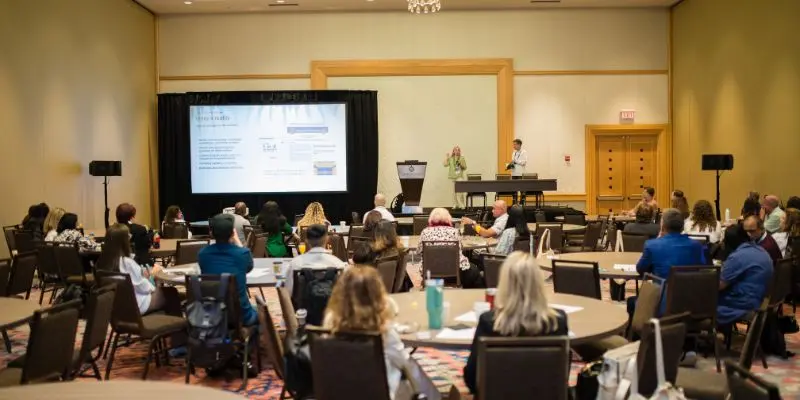
If your objective is to make 40 executives feel like insiders, a ballroom set in rounds of 10 works against you. It signals scale, hierarchy, and “conference,” not intimacy. If your objective is to unveil a new product direction that needs to feel inevitable, a room where the stage sits at the short end and attendees are packed close reads very differently than the same content in a long, half-empty room.
Seating in rounds is not the default. They’re a choice. So are theater rows, chevron sets, cabaret, salon-style, and standing reception. Each one produces a different emotional temperature in the room, and the brief is where you decide which temperature the objective requires.
Step Two: Map the Agenda Flow to the Emotional Arc You Want to Create
Once the emotional journey is named, the agenda stops being a schedule and starts being a sequence. The question changes from “what content do we have?” to “in what order do these moments need to land to move the room from A to B?”
A practical way to do this: sketch the emotional arc on a single line, left to right. Mark where the attendee arrives (say, at a 3 out of 10 on “connected to peers”). Mark where you need them by the close (an 8). Now overlay the agenda — welcome reception, opening keynote, breakouts, dinner, second-day sessions — and ask which blocks are actually doing the work of moving the number up, and which are just occupying calendar space.
Most draft agendas have two or three real load-bearing moments and a lot of connective tissue. The brief’s job is to name which moments are load-bearing so the production team knows where to concentrate the design attention, the lighting design, the audio precision, and the run-of-show rehearsal time. Everything else can be executed cleanly and simply. The moments that carry the objective get the craft.
Step Three: Brief Your Production Team Before You Brief Anyone Else
This is the sequence change that changes the outcome. Most executive experiences brief the production team at site visit — after the venue is booked, after the agenda is drafted, sometimes after the creative concept is already deep in decks. Ideally, you want to bring them into the fold much earlier in the process, preferably before the venue is even finalized.
Room selection, staging orientation, and seating configuration are downstream of the experience brief, not upstream of it. A production team briefed with the four components above will tell you which of your venue options actually supports the moment architecture, which ceiling heights kill the lighting look the concept requires, and where the sightline geometry will make the load-bearing moment feel small instead of intimate. Brought in at kickoff, they are strategic advisors. Brought in at site visit, they are executing someone else’s constraints — and the seams show in the room.
This is also where vendor fragmentation quietly costs the most. In the typical model — a creative-led agency writes the brief, briefs and subcontracts an AV partner, and handles the room design conversation separately with the venue — the brief gets translated three times before it reaches the stage. Every translation loses signal. The events where the brief actually shapes the room are the ones where the same team owns the translation from strategy to spec.
A Self-Assessment: Is Your Brief Actually Shaping the Room?
A quick test. Take the current brief for your next executive experience and hand it — mentally, or literally — to a technician who has never met you and has never worked your program. After reading it, could they answer these five questions?
- What is this event trying to accomplish for the sponsoring executive?
- Where do attendees arrive emotionally, and where do they need to be by the end?
- Which two or three moments in the agenda cannot fail?
- What has to be true about the room during those moments for them to land?
- What production constraints did the creative concept get built around?
If a technician couldn’t answer question three, the brief is incomplete. If they couldn’t answer question four, room design has been left to the venue. If they couldn’t answer question five, the concept is going to get revised on-site, which is the most expensive place to revise anything.
The brief doesn’t need to be beautiful, it just needs to survive a handoff.
What Integrated Planning Looks Like When It’s Working
When the brief actually shapes the room, a specific thing happens: the event looks in person the way it looked on paper. Not because the partners got lucky, but because there was no translation gap between the strategy and the spec.
The cleanest way to close the translation gap is to shrink the number of teams the brief has to travel through. When creative direction, event planning, and production execution all sit under one accountability, the four-component brief moves through one team instead of three. The room design decision made in the brief is the room design decision executed on load-in day. Nothing gets lost in the handoff because there isn’t one.
This is also what makes executive experience budgets defensible after the event. A CFO doesn’t ask whether the AV worked. A CFO asks whether the objective got met — whether the top 40 accounts actually feel like insiders now, whether the sales kickoff actually reset the year, whether the investor day actually landed. Those outcomes trace back to the brief, and to whether the room was shaped by it.
If you’re rebuilding your executive experience process this year and want to pressure-test how your brief translates into room design and moment architecture, Talk to Our Team. We’re happy to walk through what we’ve seen work — and what usually doesn’t — across recurring executive programs.

Cindy Chea is the Content Specialist at Meeting Tomorrow. Whether it’s design, research, social media, or writing, she loves all things content and applying it to the world of events. A digital storyteller at heart, she thrives on transforming complex information into engaging, visual stories. At Meeting Tomorrow she helps ensure brand consistency across our platforms and develops creative content solutions for our team and the event professionals we support. When she’s not editing or looking for event inspo, you can find her journaling in a coffee shop or searching for the best bread basket in Philly.