
If you run a corporate event program of any size, you’ve probably seen an LED poster demo in the last twelve months and had the same reaction most event planners have: it looks great, and the quote made your eyebrows go up. The question isn’t whether LED posters are impressive on the show floor. The question is whether the premium cost actually pays back against what you’re already spending on foam core, vinyl, and rush reprints — and how you’d even build that math for a leadership team asking why signage suddenly costs more.
In this guide, we’ll walk through where the cost comparison gets misleading, how to calculate cost-per-update for your specific program, where LED posters genuinely outperform print, where they don’t, and what to ask before you commit to either format.
Why the Upfront Cost Comparison Misleads Most Event Planners
The first mistake most teams make is comparing the wrong two numbers. The rental quote for an LED poster looks like a lot next to the invoice for a single foam core sign.
But that’s not the real comparison. Print signage isn’t a one-time cost. It’s a program-level cost that shows up in three places you may not be tracking together:
First, there is the initial print run for agenda boards, directional signs, sponsor recognition, session titles, and wayfinding. Then come the inevitable change orders; every speaker swap, session time correction, or a last-minute sponsor. Each change triggers a reprint, often at a rush fee.
Once you take in those considerations for a full year of events, the LED conversation looks different. The sticker price of the rental hasn’t changed — but the print number you’re comparing it to just doubled.
The Real Math: How to Calculate Cost-Per-Update for Your Event Program
Here’s a framework that actually answers the finance question. Instead of comparing unit prices, compare cost-per-update across a full program year.
Step 1 — Total your annual print signage spend. Pull the last four quarters. Include the initial print runs, every reprint invoice, every rush fee, shipping between cities, and on-site production of last-minute correction signs. Most planners we work with are surprised by this number; in our experience, the reprints and rush fees are often a significant portion of the total.
Step 2 — Count your annual content changes. For each event in your program, roughly estimate how many times signage content changed between the initial print order and the day the event ended. Speaker swaps, room reassignments, sponsor logo updates, session time shifts. Multiply by events per year.
Step 3 — Divide. Annual print spend ÷ total content changes = your current cost-per-update baseline. This is the number you compare against LED, not the sticker price of a single poster.
Step 4 — Model the LED alternative. LED poster rental amortized across the same event count, plus content update labor (which is dramatically lower — a designer pushing a new file to a display beats reprinting, shipping, and installing every time).
The break-even math varies by program, but the shape is consistent: the more events you run, the more cities you cover, and the more frequently your content changes, the sooner LED pays back. In our experience, for teams running a high volume of events per year with meaningful late-breaking agenda changes across multiple cities, the crossover happens faster than most finance leaders expect.
Where LED Posters Outperform Print (and Where They Don’t)
LED wins clearly in a few situations:
- High content change rate. Executive summits and user conferences where the agenda evolves through the week of the event. Every change is a $0 marginal cost on LED and a reprint on foam core.
- Multi-day programs. Day 2 updates (yesterday’s winner, today’s schedule shift, tonight’s dinner venue) happen without an extra print change at 6 am.
- Multi-city recurring programs. One digital asset, updated centrally, deployed consistently. No version-control problems where Chicago has the corrected agenda and Charlotte doesn’t.
Where print still wins:
- Small single-day events with stable agendas and no content changes after the doors open.
- Venues without adequate power access or floor placement clearance for LED units, which is a real question worth asking before you commit.
- Environments with strong ambient light or outdoor placement where LED brightness and visibility become a design problem rather than a solved one.
The honest answer is that LED is not universally the right choice. It’s the right choice for a specific program profile — high event volume, high content-change frequency, multi-city rotation, and venues that can physically support the format.
The Sustainability and Sponsor Inventory Case
Two arguments for LED rarely show up in the initial cost comparison, and both matter more than they used to.
Sustainability. Single-use foam core and vinyl signage is a documented event-industry waste stream. For organizations with public ESG commitments, the material reduction from eliminating single-use print signage is quantifiable and reportable.
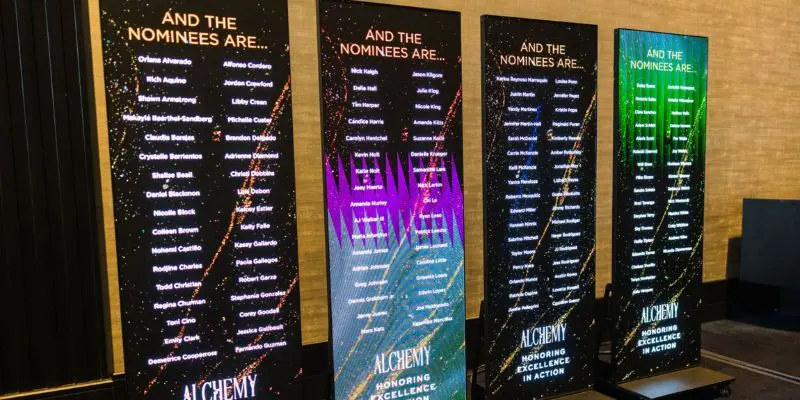
New sponsor inventory. This is the one most planners under-appreciate. Print signage caps your sponsor inventory at the number of physical placements you can install. LED posters unlock rotating, time-boxed, category-exclusive digital placements that have no print equivalent. That’s not a cost reduction — it’s a new revenue line that didn’t exist before. When you’re modeling ROI, this offset changes the calculation materially, especially for annual conferences and user summits with strong sponsor programs.
How to Assess Whether Your Event Program Is a Good Fit for LED
A quick self-assessment. LED is likely a strong fit if:
- ☐ You run 10 or more events per year
- ☐ Your content changes multiple times per event on average
- ☐ You operate across multiple cities and struggle with signage version control
- ☐ Your venues generally support the power and placement requirements
- ☐ You have an active sponsor program with room to expand digital inventory
- ☐ Your organization has ESG reporting requirements or sustainability goals
LED is probably not the right first move if:
- You run a small number of stable, single-day events per year
- Your content is locked weeks in advance and rarely changes
- Your venues frequently create placement or power problems
- Your sponsor program is small or non-existent
Most enterprise event programs sit closer to the first list than the second, but not all — and the honest assessment matters more than the trend line.
What to Ask Before You Commit to Either Format
A short list of questions worth asking your production partner — whichever format you’re leaning toward — before signing anything:
1. What’s your venue compatibility process? Not every ballroom or convention space supports LED placement out of the box. Someone on your team needs to be able to answer this venue-by-venue, ideally before the contract is signed. This is where the difference between the typical national vendor model and an embedded production team shows up — knowing your venues, your power access constraints, and your placement clearances requires institutional knowledge across a multi-city program, not a one-off site check.
2. Who owns content updates on-site? The team accountable for getting a corrected sponsor logo pushed to the display at 11pm before day two is not the same as a technician who dropped off the equipment. Ask who that person is, and whether it’s the same person for every event on your program.
3. What’s the change-order pricing? For print, ask about rush fees, minimum reprint quantities, and cross-city shipping. For LED, ask about on-site content update labor and whether it’s included or a separate line.
4. What does the total program cost look like across a year, not per event? If your production partner can only quote you per event, they’re not thinking about your program the way you need them to.
The right conversation about LED versus print isn’t merely a signage conversation. It’s a program conversation — how your events run across a full year, across multiple cities, with the same team accountable from kickoff to teardown.
If that’s the conversation you’re ready to have, we’d love to hear about your program. Talk to Our Team and we’ll walk through the cost-per-update math against your actual event calendar.

Cindy Chea is the Content Specialist at Meeting Tomorrow. Whether it’s design, research, social media, or writing, she loves all things content and applying it to the world of events. A digital storyteller at heart, she thrives on transforming complex information into engaging, visual stories. At Meeting Tomorrow she helps ensure brand consistency across our platforms and develops creative content solutions for our team and the event professionals we support. When she’s not editing or looking for event inspo, you can find her journaling in a coffee shop or searching for the best bread basket in Philly.